smoke detector
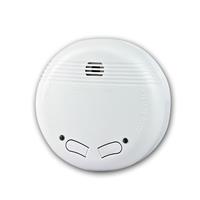
Smoke detectors enhance safety in private homes and commercial premises by detecting fire smoke at an early stage and warning of the danger with a loud audible alarm. This enables people to react more quickly, thereby reducing the risk of personal injury and property damage. Given their vital role in fire safety, Germany has statutory requirements for smoke detectors, with specific regulations set out in the building codes of the individual federal states. Additionally, carbon monoxide (CO) detectors provide warnings against dangerous, invisible, and odorless carbon monoxide.



Reliable early detection of fire smoke
Smoke detectors are one of the most important components of preventative fire protection. Optical or photoelectric smoke detectors are particularly common. Inside there is a measuring chamber with a light source and a sensor. Under normal conditions, the emitted light does not directly hit the sensor. If smoke particles enter the measuring chamber, the light is scattered and detected by the sensor. If the smoke concentration exceeds a certain value, the smoke alarm triggers a loud acoustic alarm. This means that a fire can be noticed at an early stage - this is particularly important at night, when smoke is often not noticed in time by sleeping people.
Depending on the version, in addition to classic optical smoke detectors, thermo-optical detectors are also available. These combine smoke detection with an additional evaluation of temperature development and can therefore record various characteristics of a fire. Smoke alarms are usually installed on the ceiling, as warm smoke rises and spreads there. In Germany, the specific requirements regarding the obligation to use smoke detectors, the number of smoke detectors and the rooms to be equipped are based on the applicable regulations. Proper placement and regular functional checks of the smoke detector are also crucial for reliable functionality.
Identify invisible danger in good time – protection with CO detectors
A carbon monoxide detector, or CO detector for short, performs a different task than a smoke detector. Carbon monoxide is produced when carbon-containing fuels are incompletely burned and can occur, for example, in connection with fireplaces or other combustion processes. The dangerous thing: CO is colorless, odorless and tasteless and can therefore go unnoticed without a suitable carbon monoxide detector. If the gas gets into the room air, it is absorbed through breathing and impairs the transport of oxygen in the body. A CO detector therefore continuously monitors the carbon monoxide concentration in the ambient air and warns with a clearly audible signal when dangerous values or corresponding exposure times are reached.
CO detectors do not replace smoke detectors - and smoke detectors do not replace carbon monoxide detectors. Both warning systems detect different dangers and can therefore work together to provide additional safety. Depending on the model, energy is supplied via replaceable batteries, permanently installed long-term batteries or another designated power supply. Installation also differs depending on the detector type and manufacturer's information. Smoke detectors are usually installed on the ceiling, while carbon monoxide detectors should take the manufacturer's mounting and distance requirements into account. Regular functional tests and compliance with battery warnings and the stated device lifespan help ensure that smoke detectors and CO detectors provide reliable warnings in the event of an emergency.